Stories That Stay: A Conversation on Hospitality, Education, and the Road Ahead
March 31, 2025
🎥 1. What first drew you to your study of hospitality and tourism, and what keeps you engaged in it?
My journey into hospitality started right at home. On my father’s side, my grandparents owned a winery and a couple of hotels; my other grandfather ran a local coffee/tea shop. My father operated a bus company and a restaurant, and my uncle owned a cab company. So from a very young age, hospitality wasn’t something I studied—it was something I lived. I was born into it and immersed in it long before I ever opened a textbook.
Growing up in Istanbul—especially in its historic heart, once known as Constantinople—only deepened that connection. It’s a city where continents, cultures, and centuries converge, and where hospitality isn’t just practiced—it’s part of the identity. The city’s rhythm, diversity, and constant flow of people taught me early on those welcoming others is simply how life works.
And then there’s Turkish hospitality itself—globally known for its warmth and generosity. In our culture, offering a guest a cup of tea isn’t just a gesture—it’s a message: "you matter here." That belief—that human connection is sacred—continues to inspire my work and keeps me deeply engaged in this field.
🎥 2. Tell us about a specific project you are working on right now and why it is important.
Right now, I’m writing two books that offer very different windows into hospitality. One is a textbook designed for students just entering the field—something foundational and practical to help them understand the fundamentals of hospitality and tourism management. The second is much more personal—almost like a travel companion. It encourages readers to explore the world, showing how incomplete we are if we never step outside our comfort zones to discover ourselves.
This second book blends stories from my life with lessons from the industry to show that hospitality isn’t just for hotels or restaurants—it’s a way to live. There’s how things are done, and then there’s how things are done with a hospitality mindset. Whether you're at a beach café or an airport lounge, we all have the power to make someone feel welcome. Through both books, I hope to inspire people to choose hospitality—not just as a career, but as a life philosophy. One that aims to make a difference in every moment, every interaction, and every connection. Because when we live that way, I truly believe we make the world a better place—one that's worth living in.
🎥 3. What is the most fascinating location your work has taken you to, and why was it so intriguing?
Travel, for me, is about transformation. I believe there’s no such thing as a magical place if you don’t bring the right eyes with you. That said, I may be biased—but Istanbul still feels like magic to me. It’s where chaos and beauty collide, and somehow, it works.
Outside of my hometown, Florence completely stunned me. Its art, its elegance—I could spend a lifetime there and still not get enough. And then there’s Cuba. Cuba didn’t just challenge me—it changed me. One moment you're uplifted, the next overwhelmed—it’s a place that stirs every emotion, sometimes all at once.
I seek places that leave a mark, that send me home with new eyes. Every journey returns a new version of myself. And to me, that is the real power of travel.
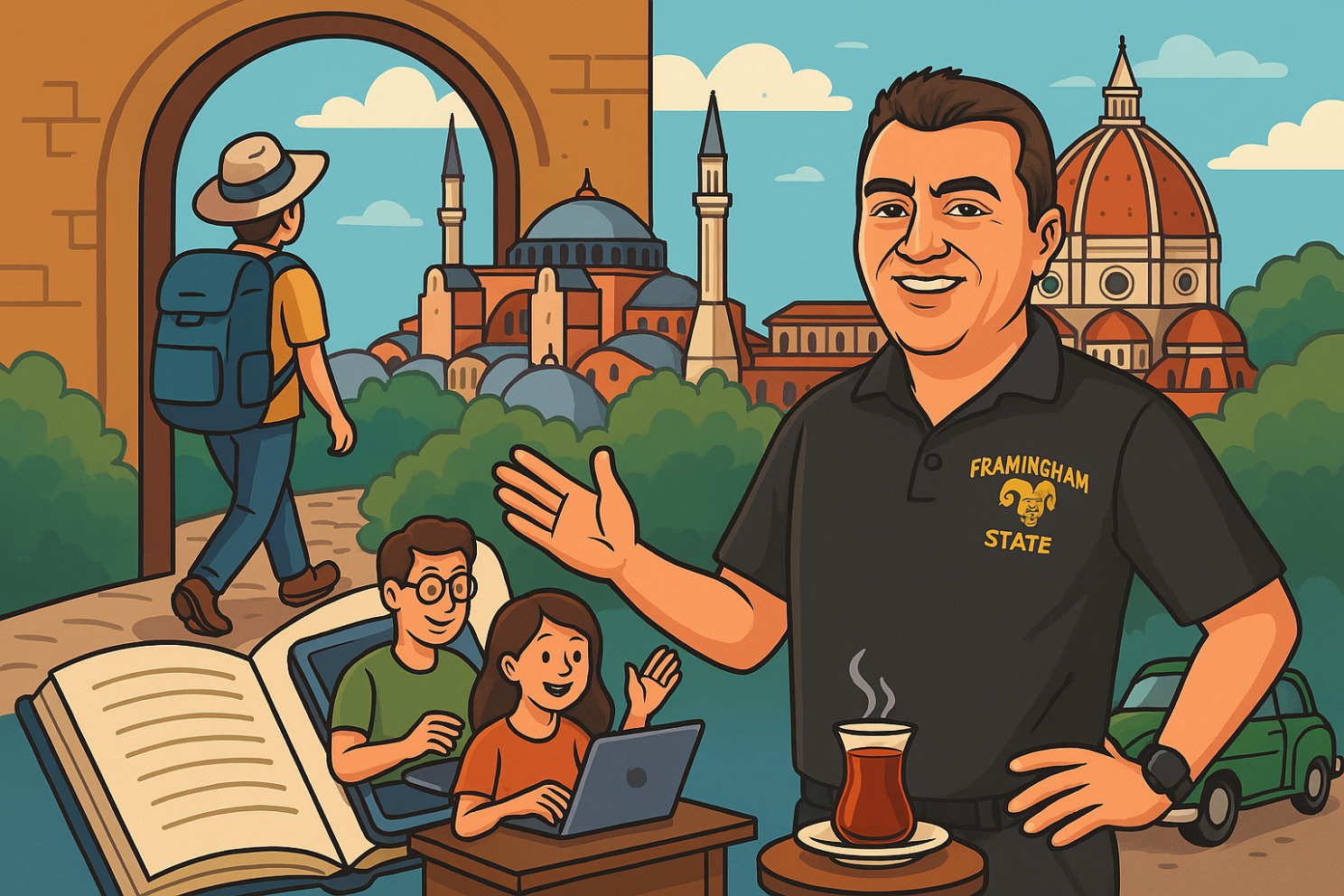
This AI-generated illustration captures moments from Dr. Palabiyik's interview, where he shares how he teaches students the hospitality mindset—drawing on rich experiences from Florence, Istanbul, and Cuba. A visual journey through learning, culture, and the transformative power of travel.
🎥 4. How do you share your work with your students, and what do they find most interesting about it?
It’s part of my teaching philosophy—I don’t really see myself as a teacher. If anything, I’m a learner. I often feel like I learn more from each class than my students do. I build my courses around real-world experience. For example, I co-create travel itineraries with students, then I actually take those trips, live those experiences, and bring the lessons back to the classroom.
My syllabus is always evolving, just like the world around us. That hands-on, storytelling approach draws students in—they’re not just reading about hospitality, they’re living it through our conversations. And every semester, I watch curiosity turn into passion. We keep traveling together—maybe not always physically, but always philosophically.
🎥 5. Would you like to discuss any interdisciplinary aspects of your research?
Absolutely. Hospitality touches every field that involves people—and even those that seem far removed, especially with today’s advances in technology. If humans are involved, hospitality matters. My research explores how we create meaningful experiences, build trust, and serve with empathy.
I focus on applied science—turning transactions into experiences as a hospitality professor, and experiences into value as a business chair. Whether I’m studying customer behavior or crisis response, I always keep the human perspective at the center. Because in any industry, if you forget the human side, you lose the heart of the work. People feel excellence—and when they’re truly impressed, success follows. Or as business people like to call it: profit.
🎥 6. How do you see the future of hospitality and tourism evolving, and what role do you think education plays in shaping that future?
I see education becoming something borderless—something that sparks connection. Just like hospitality isn’t limited to hotels, education shouldn’t be limited to classrooms. I imagine a world where everyone is both a student and a teacher, constantly learning through shared experiences. That’s how we’ll keep hospitality relevant in a changing world: by turning classrooms into communities and knowledge into action.
As we move deeper into the age of artificial intelligence, there's also a growing trend toward everything organic and authentic. I believe people will be surrounded by platforms filled with AI—but it will be natural intelligence, the human touch, that remains the true game changer. Because at the end of the day, I believe in something timeless: The Human Factor.